
Golfers Don’t Need More Information. They Need More Clarity.
Golfers have never had access to more information.
Open your phone and within seconds you can find thousands of videos explaining how to swing a golf club. Launch monitors can measure almost everything the club and ball are doing. Equipment has improved, coaching technology has improved, and players now have access to information that would have been unimaginable when I first started playing and coaching.
And yet, two of the most common things I still hear from golfers are:
“I just want to be more consistent.”
and:
“I need to be more confident.”
That has always interested me.
Because if more information was the answer, surely golfers would be improving faster than ever.
Instead, I regularly meet players who are more confused about their golf than they need to be.
They’ve watched a video about shallowing the club. Someone has told them they’re coming over the top. They’re trying to keep their head down. They’ve changed their grip. They’re thinking about their hips, their takeaway and their wrist angles.
Before long, there are so many thoughts going through their head that they’ve forgotten to look at the thing that really matters:
What does my golf ball normally do?
I don’t think golf has an information problem.
I think it has a clarity problem.
“I just want to be more consistent”
I once coached a golfer who came to me with a very common goal.
He was shooting in the mid-90s and wanted to get himself closer to the low 80s. His handicap was somewhere around 19 or 20 when we started working together.
Like most golfers at that level, there were technical areas we could improve, and we did spend time working on his swing.
But we didn’t completely rebuild it.
Instead, we did something much simpler.
We started understanding his game.
Rather than constantly searching for another technical fix, we focused on developing skills and, just as importantly, collecting evidence about what was actually happening when he hit golf shots.
Over roughly ten months, his handicap came down from around 19 or 20 to 7.
There wasn’t one miracle lesson behind that improvement.
There wasn’t one magical swing thought.
And there certainly wasn’t a secret move that nobody else knew about.
It was a process of understanding his game, developing the right skills and making better decisions.
Confidence comes from evidence
At one point during our coaching, he said to me:
“I’m just not very confident.”
I replied:
“You’re very confident about that.”
There’s a funny contradiction there.
Golfers often become incredibly confident about the things they believe they can’t do.
“I can’t hit driver.”
“I always slice it.”
“I’m terrible from 50 yards.”
“I can’t putt under pressure.”
But ask the same golfer exactly how far they carry their 7-iron, what their normal shot pattern looks like, or what percentage of drives actually finish in a playable position, and the answers often become much less certain.
That’s where I think we sometimes misunderstand confidence.
Confidence isn’t something you can simply switch on. It comes from evidence.
Telling yourself to “be confident” isn’t particularly useful if you have nothing to base that confidence on.
But if you hit a particular shot over and over again, measure the results and start to understand your normal pattern, you begin to build genuine reasons to trust what you can do.
That is a much stronger form of confidence.
Stop changing things and start measuring them
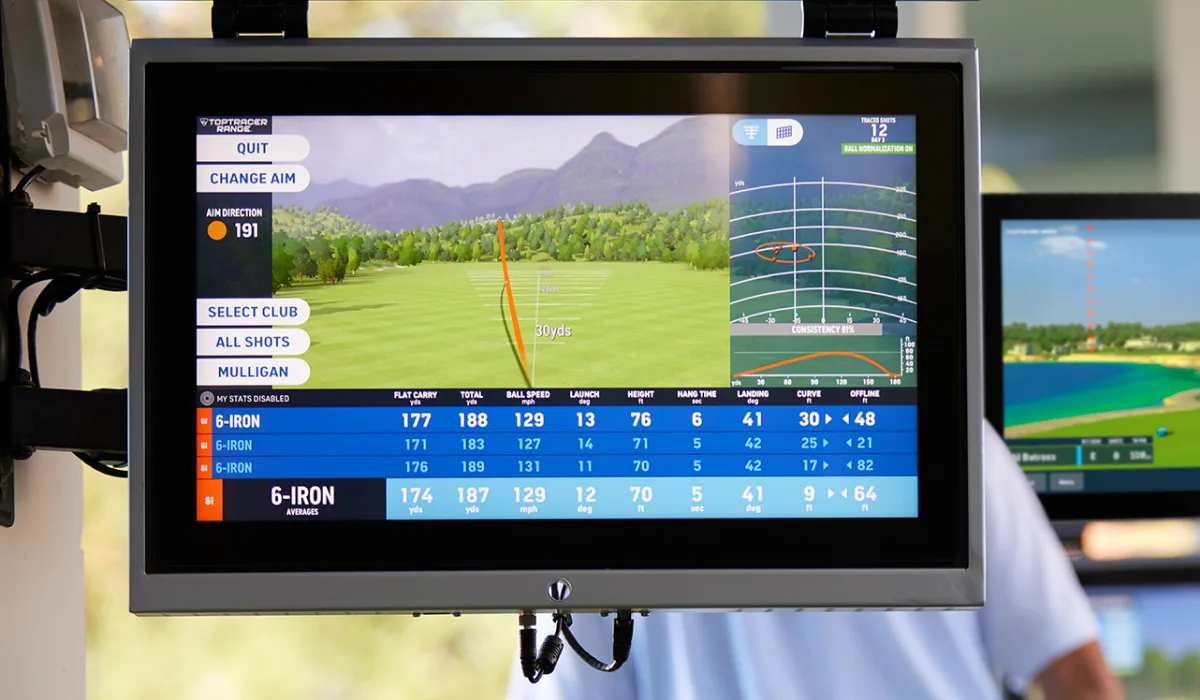
One of the simplest exercises I use with golfers is something almost anyone can do now using technology such as Toptracer or GCQuad.
Choose a club and hit 20 to 30 normal shots.
At first, don’t try to fix anything.
That part is important.
Don’t suddenly change your grip. Don’t try the swing tip you watched the night before. Don’t manipulate your swing because you think the numbers are supposed to look a certain way.
Just hit golf shots.
Then look at what actually happened.
What was your average carry distance?
How much did that distance vary?
Which direction did the ball normally go?
What was your most common miss?
How wide was your normal dispersion?
Repeat the exercise with different clubs and you gradually start building a much clearer picture of your golf game, rather than the golf game you think you have.
The golfer I mentioned earlier eventually knew things like:
“My 7-iron carries about 142 yards.”
Not because a chart told him how far someone with his handicap should hit it.
Because we had measured it.
More importantly, he understood the variation around that number too.
With his driver, he knew his normal pattern was a small fade. He understood roughly how far it carried and how often that pattern left him in a playable position.
Suddenly, we weren’t dealing with feelings or guesses anymore.
We were dealing with evidence.
Understand first, then consider changing something
This is where I think golf coaching can sometimes become more complicated than it needs to be.
It is very easy to begin with the question:
“What do we need to change in your swing?”
I would rather start with:
“What actually happens when you play golf?”
Measure what is happening first.
Understand the pattern.
Work out what is genuinely costing you shots.
Then, if a technical change is needed, make one.
Sometimes it absolutely is.
I’m a golf coach, so of course technique is an important part of what I do.
But every technical change should have a purpose.
The aim isn’t to create the most beautiful golf swing possible.
The aim is to help someone play better golf.
Those two things are not always the same.
Consistency doesn’t mean perfect golf shots
There’s another misunderstanding hidden inside the word “consistency”.
A lot of golfers imagine being consistent means hitting almost identical shots again and again.
That isn’t golf.
Even the best players in the world have dispersion. They miss targets. They hit poor shots. Their golf balls move in different directions.
The difference is that they understand their patterns.
The goal isn’t to remove every bit of variation from your game.
It is to understand that variation well enough to make better decisions.
If you know your 7-iron normally carries around 142 yards and you understand the range around that number, you can make a much better club choice when there is water short of the green.
If you know your driver usually fades, you can choose a target that gives that shot shape enough room.
That is part of playing good golf.
Every time you see those patterns repeat, you collect more evidence.
More evidence creates more understanding.
And more understanding gives you more confidence.
Golf doesn’t need to be this complicated
Technology should make your golf game clearer.
It shouldn’t simply give you another hundred things to think about.
That is a big part of my philosophy as a coach.
I don’t believe my job is to show a golfer how much I know about the golf swing.
My job is to help the person standing in front of me understand their game.
What actually matters?
What doesn’t?
What is really costing them shots?
What should they practise?
What can they stop worrying about?
And how will we know when they are improving?
That is clarity.
I think a lot of golfers would improve more if they spent less time searching for the next swing tip and more time understanding what is already happening.
So next time you practise, try something slightly different.
Don’t immediately try to change your swing.
Choose a club.
Hit 20 to 30 shots.
Measure them.
Observe the results.
Learn your distances.
Learn your patterns.
Learn your misses.
Understand first. Change second.
Because you probably don’t need more golf information.
You need more clarity.